
Looking for my bylines (last seen on the internet): Authorship and attribution in online content writing
This story explores the complexities of maintaining a writer's sense of identity in an online world, where the lines between authorship and ownership are blurred.
Authorship online...



About the author and artist
Hi, my name is Zara M. I'm a writer and cartoonist who tells personal stories and shares thoughts and ideas through my lived experience of living and working with a mental health disorder.
I'm currently working on a graphic memoir exploring burnout, redundancy, unemployment, and antidepressant withdrawal through diary-style comics drawn from my lived experience. You can follow my work here on LinkedIn or visit my website below to see more.
I'm open to commissions for illustrated essays, visual storytelling (including drawn journalism), editorial cartoons, and short- and long-form comics.
Full text version of the comic (for accessibility)
A whole archive of my work has disappeared! My author page on a brand’s website, where years of published articles used to sit under my name, is suddenly empty. I know that the copyright to the work doesn't belong to me, according to the standard contracts you sign when employed as a staff writer, but discovering that my work has been republished under other people's names was rough. This isn't personal, Zara, I told myself, but I was heartbroken – seeing my author page empty felt like I had been erased.
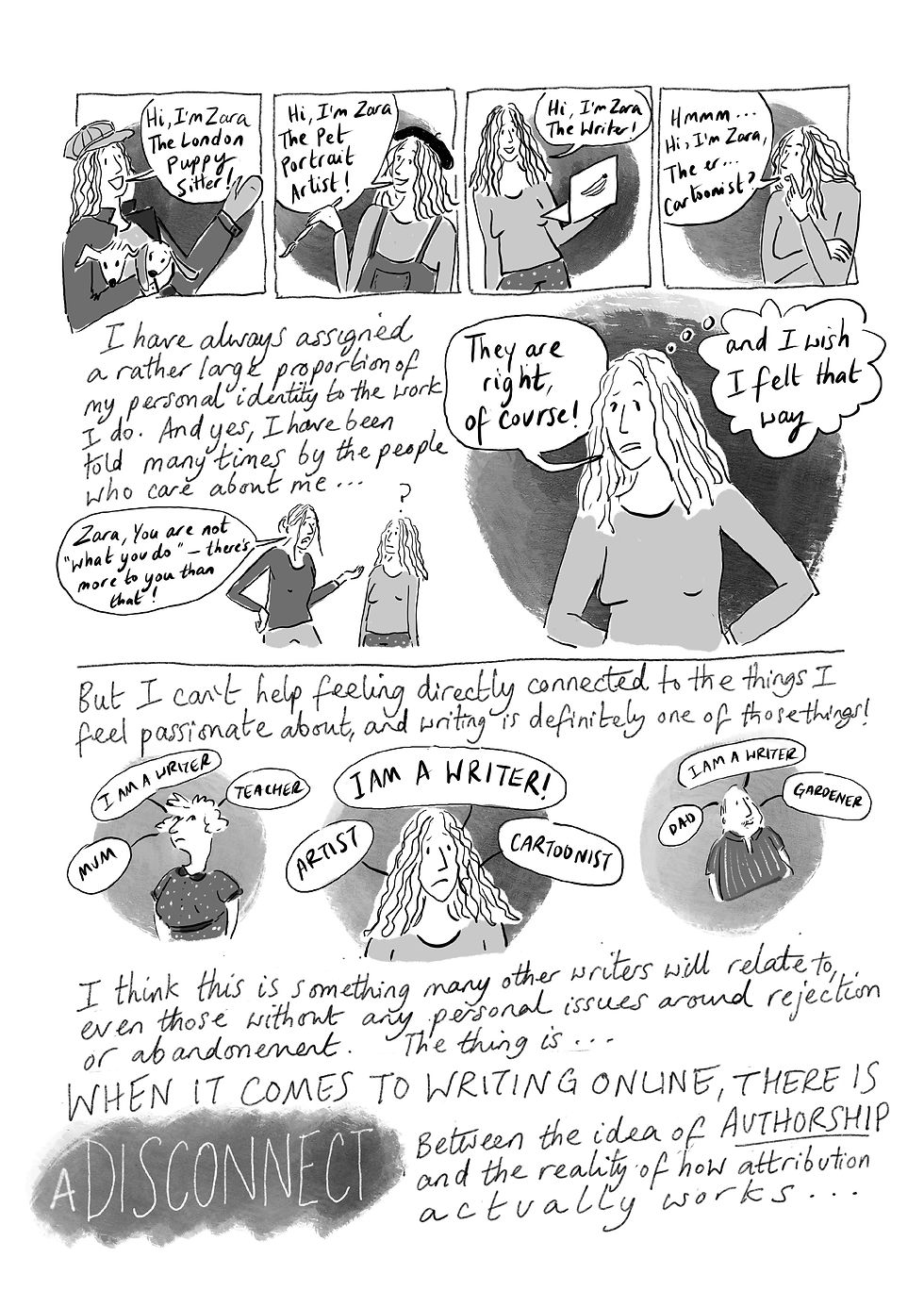
I don’t deal well with rejection, even when it’s not actually rejection, and so this discovery was pretty triggering for me. As a writer, I have always assigned a large part of my personal identity to my work. And yes, I have been told many times by people who care about me that I’m not what I do, that there’s more to me than that. They are right, of course, and I wish I felt that way. But I can’t help but feel connected to what I am passionate about, and writing is definitely one of those things. I think this is something many other writers will relate to, even those without any particular issues around rejection or abandonment. When it comes to writing online, there is a disconnect between the idea of authorship and the reality of how attribution actually works.
There's often an assumption that bylines are a lasting attribution to the original author, but with digital publishing, things get complicated. Author pages are not fixed archives. They shift over time, depending on how content is updated, rewritten, or reassigned within a team. Articles can be refreshed for accuracy, search performance, or relevance, and sometimes that means the byline changes as well.
As a staff writer, I became used to working within this system. I updated older articles, sometimes substantially, and was regularly assigned existing pieces to refresh for accuracy or SEO purposes. Authorship is not always tied to who originally wrote the piece, but to who worked on it last. This is something many readers are blissfully unaware of. It certainly came as a surprise to me when I moved from freelancing into a full-time staff writing role.
As a freelancer, I understood that the rights to my work were being purchased – it was a clear exchange. I was paid per article or per batch, and the work was often published anonymously or under someone else’s name. I didn’t particularly like it, but I accepted it as part of the arrangement, imagining my role was akin to that of a ghostwriter. Except I wasn’t being paid like a ghostwriter – more fool me!
The reality – transitioning from freelancing to a staff writing role – was disillusioning. I thought it was a new opportunity to develop a meaningful archive of work, published under my own name, at last! It felt like I was finally going to be a “real” writer and actually get recognition for my writing – bless my pure, naive little soul. I had to adjust my expectations when I discovered that a large part of the job was actually updating old articles written by other writers. It makes sense, I suppose, that when adding so much new content to a piece, the byline is changed to reflect a new author for the updated work.
I have to say I was grateful for this, as I think I’d have gone insane if I'd discovered that my new job as a staff writer was to make other writers’ work shine, without any recognition for my own skill and effort. That would have been a dark, dark time. However, I also learned that it was common for very old articles without an author to be assigned to me and republished under my name, regardless of whether I had made many (or any) changes, simply because it needed an author. As if I didn’t struggle with enough imposter syndrome of my own, I found this incredibly difficult, as I hated the idea of having any piece of writing attributed to me if I hadn't actually written it.
As time passed, I had to let go of the idea that my author page was a true reflection of my personal skill, effort, or output. It exists to tell search engines that the articles have an author who is actively producing content on the site, and who is considered an authority in their field. Besides, articles that appeared on my author page because I had been attributed to them could just as easily disappear again if that attribution changed. Sigh.
I’ve had to come to terms with the fact that content writing is functional and generally not author-led. For myself, and I suspect many other writers out there, this means our personal portfolios can feel unstable, especially when we need to provide links to articles to showcase our work, only to find our bylines have changed to someone else’s name – awkward! It becomes difficult to evidence past work, and we’re left without reliable long-term credit for what we’ve contributed.
Despite being jarred by the discovery of my newly emptied author page, it's a reality check that has strengthened my reasons for changing career direction and has helped to clarify my priorities as a writer and creative. I want to shift towards work where authorship is retained, something that feels more achievable when visual art is involved, like cartoons and comic strips.
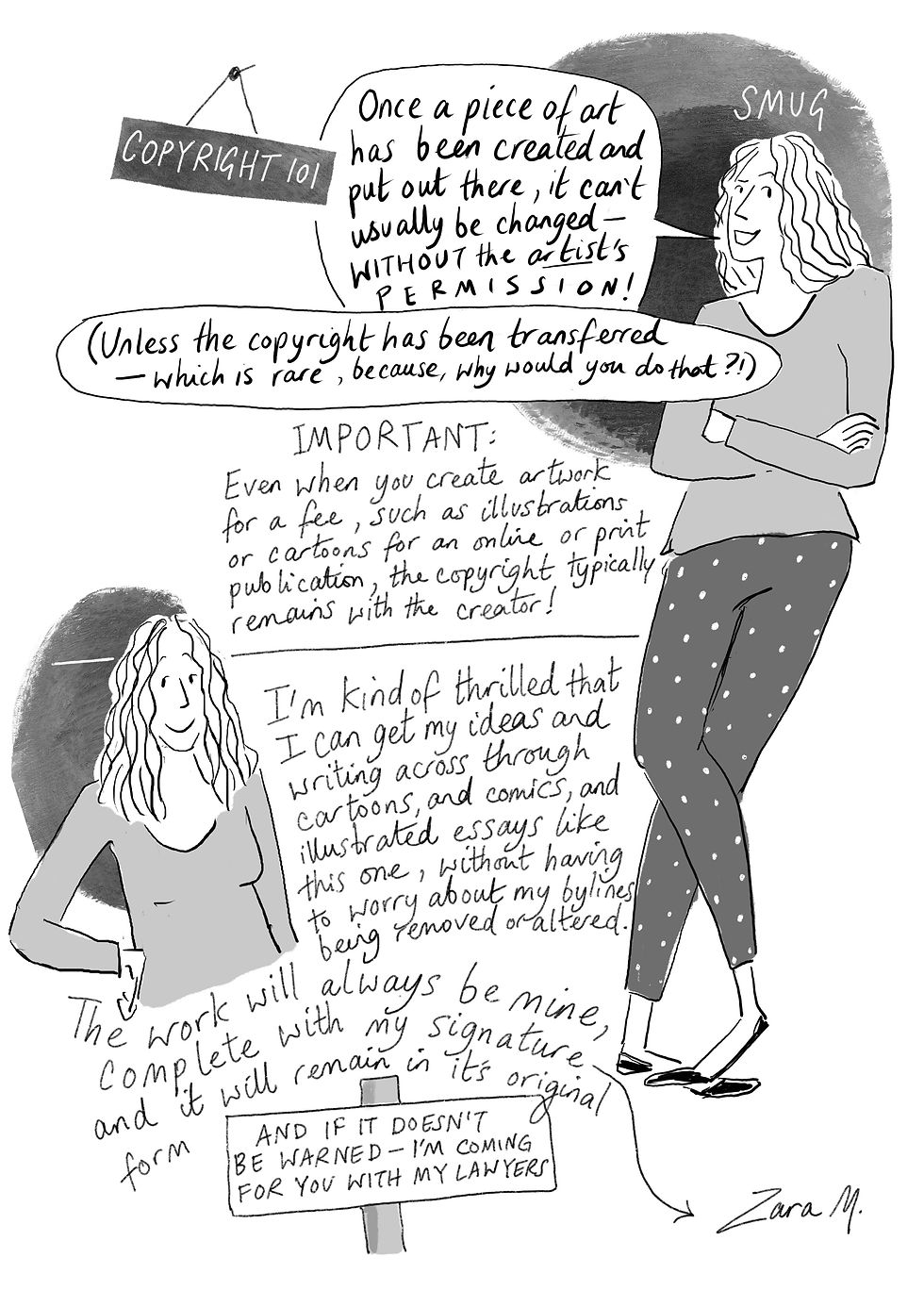
Once a piece of art has been created and sent out into the world, it can’t usually be changed without the artist’s permission, unless the copyright has been transferred, which is relatively rare. Even when you create artwork for a fee, such as illustrations or cartoons for an online publication, the copyright typically remains with the creator.
I’m kind of thrilled that I can get my ideas and writing across through cartoons, comic strips, and illustrated essays like this one, without worrying that my bylines might be removed or the work altered. The work will always be mine, complete with my signature, and it will remain in its original form. If it doesn’t, be warned – I’m coming for you with my lawyers.


Comments